The Real Cost of Publishing an Indie Novel
When readers find out I’m an author, one of the assumptions I encounter most often is that writing the book is the hard part.
Don’t get me wrong. Writing a novel takes a tremendous amount of time, energy, and persistence.
But the more I navigate the publishing world, the more I’ve realized that writing the book is only the foundation.
I thought it might be fun to pull back the curtain a little and share some of the realities of indie publishing. Not because I’m looking for sympathy and not because I’m trying to discourage anyone from pursuing publication.
Quite the opposite, actually.
If you’ve ever been curious about what goes into publishing a book—or if you’ve secretly wondered whether you might write one yourself someday—this post is for you.
Plot Twist #1: I Knew Publishing Would Cost Money
One thing that may surprise readers is that very little about indie publishing surprised me.
Before I ever published my first book, I spent countless hours researching the industry.
I read blogs.
I listened to podcasts.
I watched videos.
I studied what successful authors were doing.
I knew books needed editing.
I knew covers mattered.
I knew marketing existed.
I knew publishing wasn’t free.
What surprised me wasn’t the costs.
What surprised me was how many moving parts needed to come together at roughly the same time.
Writing.
Editing.
Cover creation.
Newsletters.
Promotions.
Websites.
Audiobooks.
Reader communication.
Future books.
Current books.
And somehow all of those pieces have to keep moving while you’re trying to write the next story.
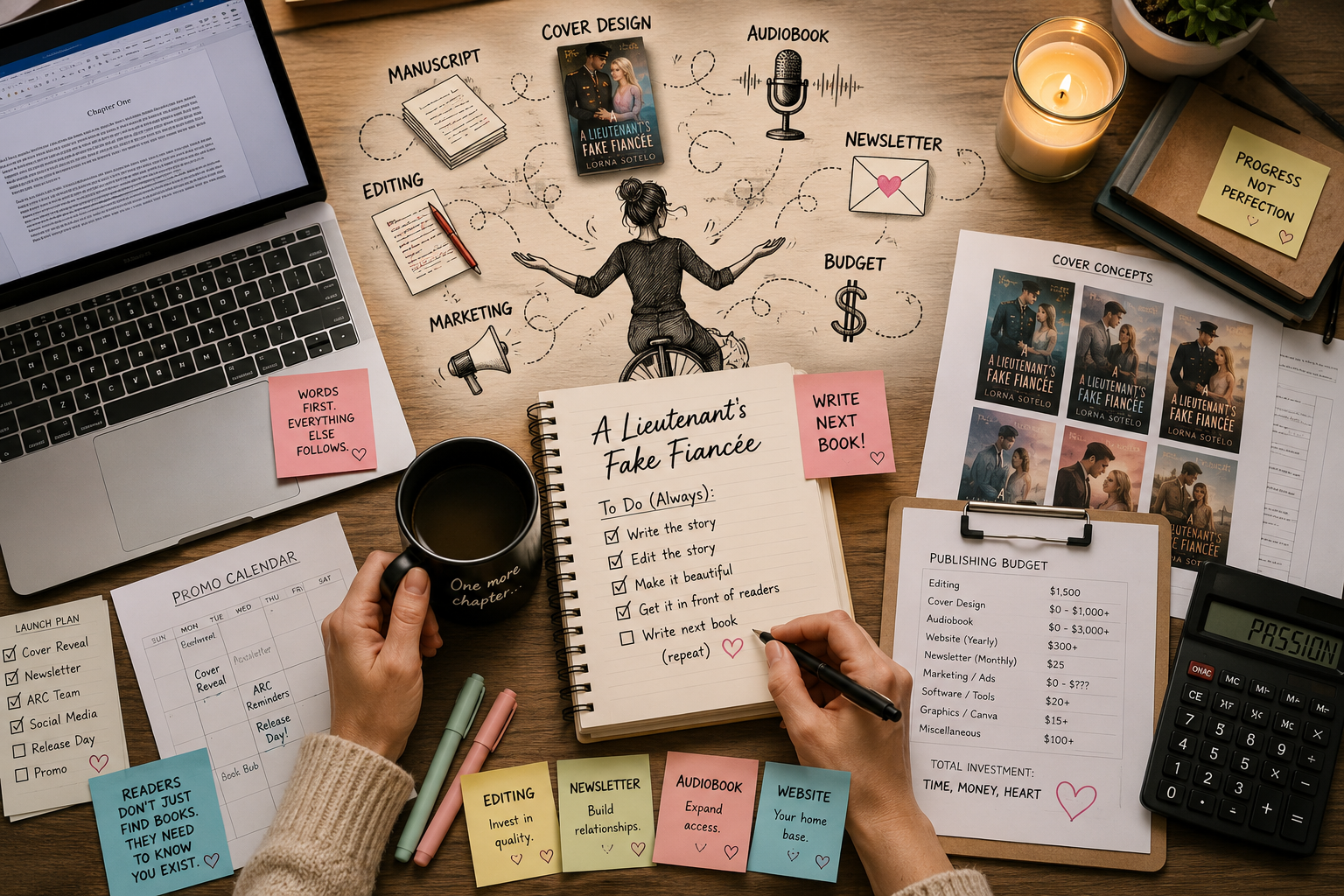
It’s less like following a checklist and more like juggling while riding a bicycle.
Plot Twist #2: Writing the Book Is Often the Cheapest Part
Financially speaking, the manuscript itself costs me very little beyond time.
A lot of time.
The expenses begin after I type “The End.” (Which I’ll probably never do, because “the end” never sits right with me when I read a good book. I don’t want it to end, I want the characters to continue on.)
Editing can range from several hundred dollars to several thousand dollars depending on the service and the length of the manuscript.
Cover design can cost anywhere from around a hundred dollars to well over a thousand.
Website hosting, newsletter services, advertising, promotional graphics, software subscriptions, and audiobook production all add their own costs to the equation.
By the time a book reaches readers, many indie authors have already invested hundreds or thousands of dollars into the project.
And that’s before a single copy has been sold.
Plot Twist #3: There Isn’t One Right Way to Publish
If you spend enough time in author circles, you’ll find no shortage of advice.
Run ads.
Don’t run ads.
Rapid release.
Write faster.
Publish slower.
Use this service.
Avoid that service.
Do this.
Never do that.
At some point, every indie author has to decide which advice fits their goals, their budget, and their life.
I’ve learned that sometimes the best solution is simply the one that works.
I’ve used AI tools to help create covers.
I focus heavily on marketing methods that are free or low-cost.
I look for ways to stretch my publishing budget without sacrificing the reader experience.
Could I spend more money on every aspect of publishing?
Sure, if circumstances allowed.
Most authors probably could.
But part of being an indie author is learning how to make smart decisions with the resources available to you.
Plot Twist #4: Every Book Is a Business Decision
Since we’re talking about the realities of indie publishing, I thought I’d share a few examples from my own journey.
Keep in mind that every author’s path looks different. Some spend significantly more than I do. Others spend less. These are simply the choices I’ve made while building my publishing business, and trying what works for me.
My website and blog initially cost about $600 for web design, and costs me roughly a few hundred dollars each year between hosting, domains, and the various tools needed to keep everything running smoothly.
Looking back, that was one of the smartest investments I made. I received a professional website without spending thousands of dollars, which simply wasn’t an option for me at the time.
Not only was I able to have it professionally done, but I could have easily spent thousands of dollars on it, which of course I couldn’t afford, so I’m happy with the result.
My newsletter service costs around $25 each month. That’s an expense I gladly pay because it allows me to stay connected with readers, share book news, and build relationships that don’t depend on social media algorithms.
Editing is one of my largest investments. Depending on the project and editor, it could cost around $1,500 on editing for a single novel. It’s not a small expense, but I was thankfully blessed to find a great editor that was willing to work with me and my budget and gave me a generous deal. I used to think that if you were good enough of an editor yourself, you didn’t need to hire a professional editor. But after working with one multiple times now, the value she brings to my book stands out. So if you’re going to skimp, don’t skimp on editing. Having a professional editor is one of the best investments an author can make in the quality of a book.
Cover design is one area where I’ve chosen a different approach than many authors. Rather than hiring out every cover, I’ve spent time learning how to create covers using AI tools and my own design process. That allows me to keep costs much lower while still creating covers that fit my books and my brand.
I know this goes against much of the advice you’ll hear in publishing circles, but every author has to make decisions based on their budget and circumstances.
I can’t afford top dollar for a cover, and any I can afford to hire out are going to use AI anyway, so I decided to do that myself. I can always invest in premium covers later.
Audiobooks are another interesting example. For The Sergeant’s Marriage Arrangement, I worked with my narrator through a royalty-share agreement. That meant I didn’t have to pay thousands of dollars upfront for production costs. Had I chosen a pay-per-finished-hour arrangement instead, the audiobook could easily have cost several thousand dollars before it ever reached listeners.
What’s interesting is that none of these expenses come with guarantees.
I can spend money on editing, covers, websites, newsletters, and audiobooks and still have no way of knowing exactly how a book will perform once it’s released.
That’s part of the risk every indie author accepts.
Every release involves balancing budgets, timelines, priorities, and goals while trying to create the best possible experience for readers.
In many ways, indie authors aren’t just writers.
We’re small business owners who happen to sell stories.
Plot Twist #5: Most Indie Authors Aren’t Getting Rich
This is probably the biggest misconception I encounter.
Are there indie authors making excellent incomes?
Absolutely.
There are also thousands of authors quietly investing money into their businesses while building their readership one book at a time.
Many books never earn back every dollar invested in them.
Some break even.
Some do very well.
Most authors fall somewhere in the middle, continually reinvesting into future books and hoping to grow a little more with each release.
The reality is that many indie authors are small business owners as much as they are writers.
Plot Twist #6: The Timeline Is Sometimes Harder Than the Cost
This is the one I never fully appreciated until I started doing it myself.
Publishing isn’t just about paying for things.
It’s about coordinating things.
Editors have schedules.
Narrators have schedules.
Promotions have schedules.
Readers have expectations.
Life has a schedule too, whether we like it or not.
Sometimes those schedules line up beautifully.
Sometimes they don’t.
One of the reasons I recently removed the preorder for A Lieutenant’s Fake Fiancée was because I wanted the flexibility to release the book when it was truly ready rather than forcing a timeline that no longer fit my circumstances.
As many of you know, life has been exceptionally busy while caring for my dad. Writing is still happening. Progress is still being made. But I’ve learned that sometimes flexibility is one of the greatest advantages of being an indie author.
Plot Twist #7: I’d Still Do It Again
After reading all this, you might be wondering why anyone would choose to do it.
The answer is simple.
I love stories.
I love creating characters who feel real.
I love hearing from readers who connected with a book.
I love opening an email from someone who stayed up far too late because they couldn’t stop turning pages.
Those moments don’t show up on royalty reports.
They don’t appear on spreadsheets.
But they’re often the reason authors keep going.
Publishing books requires time.
It requires patience.
It requires financial investment.
It requires constant learning.
But for me, the reward has never been found solely in book sales.
It’s found in the stories themselves and in the readers who choose to spend a few hours living inside them.
And honestly?
That’s worth a lot.
Deepening The Plot and Signing Off
Before I wrap up, I want to be clear about one thing.
I didn’t write this post to complain about publishing costs or suggest that authors deserve special treatment.
I wrote it because I think readers are often curious about what happens behind the scenes, and because aspiring authors deserve an honest look at the realities of the industry.
This is by no means a comprehensive list when it comes to publishing expenses. It all depends on the method an author chooses to pursue.
The truth is that there are countless ways to publish a book.
Some authors spend far more than I do.
Some spend less.
Some focus heavily on advertising.
Some focus on newsletters.
Some hire professionals for every step.
Others learn to do much of it themselves.
There isn’t one right path.
There are only choices, trade-offs, and a willingness to keep learning.
For me, indie publishing has been a constant balancing act of time, money, creativity, and faith. I’ve made mistakes. I’ve found shortcuts. I’ve discovered things that work surprisingly well and things that don’t work at all.
And through it all, I’ve continued learning.
If you’re a reader, I hope this gave you a little glimpse behind the curtain.
And if you’re an aspiring author, I hope it encourages you rather than discourages you.
Publishing isn’t easy.
But neither is writing a book.
If you have a story to tell, don’t let the challenges convince you not to tell it.
Just be prepared to learn a few new skills along the way.
Trust me, you’re going to need them.


0 Comments